Abdullahi Hassan
Black Hawk DownAbdullahi Hassan, known as Firimbi, was Mohamed Farrah Aidid’s propaganda minister and the custodian of captured pilot Michael Durant. The book presents him as both an agent of Aidid’s political cause and the person responsible for Durant’s immediate safety, a role in which the captive’s care became inseparable from the image Hassan hoped Somalis would present to America.
Identity and Role
Hassan was a tall, broad man with long arms, large hands, a pot belly, and thick, black-framed glasses. A propaganda minister for Mohamed Farrah Aidid, he was placed in charge of Durant after Aidid’s men bought the pilot back from the bandits who had kidnapped him. Hassan’s authority over the captive came with a direct threat: he was told that if Durant suffered harm, the same would be done to him.
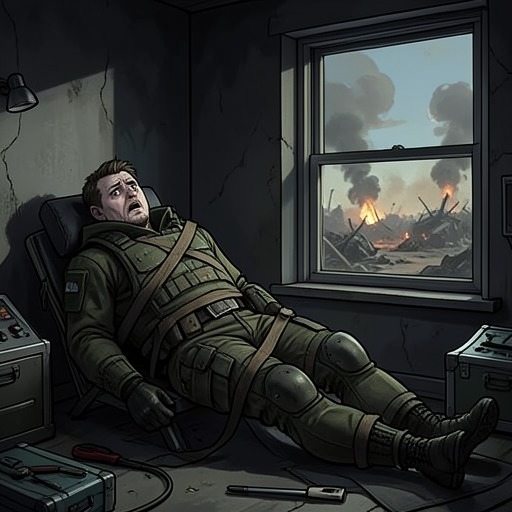
Durant was brought to Hassan’s apartment during the second night of his captivity in Mogadishu. He arrived angry, frightened, and in pain, with a compound-fractured right leg and a wounded shoulder that had swollen and become infected. Hassan greeted him, but Durant did not respond. He then helped wash and bandage Durant’s wounds and passed along word that the pilot needed a doctor. Hassan’s first actions as custodian thus combined the coercive circumstances of captivity with practical care for a badly injured prisoner.
A Relationship Under Captivity
For several days, fear of execution or torture remained with Durant, but it eased as his captivity continued. The danger he most feared shifted toward discovery by the Somali public—a fear Firimbi shared. The two men were together day and night for a week, and the book describes Firimbi as having grown fond of the pilot. That attachment did not arise outside the prisoner's struggle to survive: Durant deliberately worked at the relationship, applying the survival training that shaped how he dealt with his captor.
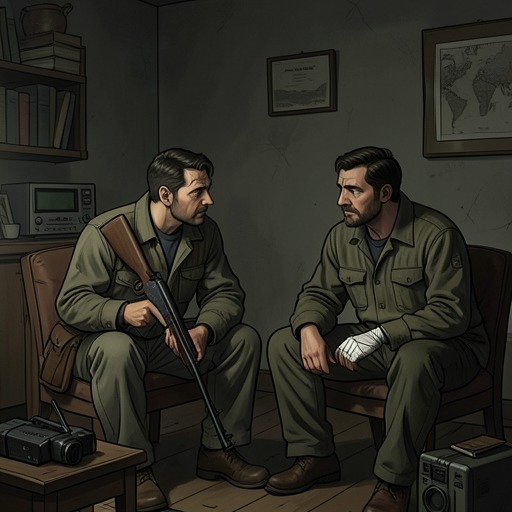
Their communication was limited but not absent. Firimbi spoke Italian, while Durant knew some Spanish; the languages were similar enough for them to manage a minimal exchange. Small acts filled the gaps. When a guard appeared to offer khat, Firimbi gestured toward Durant, who understood and nodded to ask for some too. As soon as the guard left, Firimbi took both piles for himself, winking and grinning at the pilot. The moment shows a playful familiarity developing within an arrangement still defined by confinement and unequal power.
Firimbi's identification with Durant appeared most clearly in their shared discomfort. When Durant refused food, Firimbi refused it as well; when pain kept the pilot awake, Firimbi could not sleep either. He asked Durant to promise that, if released, he would tell others how well he had been treated, and Durant agreed. Care and public purpose were intertwined: Firimbi regarded Durant as a prisoner of war and believed humane treatment could improve Americans' image of Somalis after the pilot's release.
That concern surfaced when helicopters flew over at night broadcasting that Durant's friends were looking for him. Firimbi asked what the announcement meant; after Durant translated it, Firimbi protested that they were treating him well. The care was concrete, though not comfortable: a doctor set Durant's broken leg in a cast, and after he was first fed stale military rations, the woman who owned the house slaughtered a goat and served meat and spaghetti. The meal left Durant with severe diarrhea, and Firimbi helped keep the bedridden pilot clean. His custodianship thus included intimate, unglamorous nursing as well as an insistence that Durant carry a favorable account of his treatment beyond captivity.
Captivity in the Public Eye
The public images surrounding Durant’s captivity gave the question of his treatment a national political charge. On October 4, Americans saw reports of eighteen U.S. soldiers dead, more than seventy wounded, and hundreds of Somalis dead; footage showed an American body being dragged through Mogadishu by an angry crowd. President Bill Clinton watched the images in San Francisco and demanded to know who had authorized the mission, which had been mounted without informing him. The next day, members of Congress grilled Secretary of Defense Les Aspin and Secretary of State Warren Christopher about how the raid had happened and why American soldiers were dying in Somalia. Against this public record of violence, Hassan’s belief that humane treatment could improve Americans’ image of Somalis gave his custodianship a political dimension, even as the book does not depict him directing the coverage or answering the U.S. debate.
Durant’s filmed questioning further shows the precariousness of a captive’s public voice. During an interview, an unidentified Somali interviewer pressed him about his identity and the task force’s purpose; the Somalis regarded all the Americans with the task force as Rangers. Durant corrected him, saying he was a pilot, while the interviewer accused the Americans of killing innocent people. Durant responded that the killing of innocent people was not good. The exchange does not establish Hassan’s involvement, but it sits beside his effort to secure Durant’s promise to describe his treatment favorably: in captivity, the pilot’s words could become part of the struggle over how Somalis and Americans would be seen by one another.
The Counterimage of Captivity
Early the next morning, back at the base, wounded Rangers and Commando soldiers watched footage of Somalis celebrating on the rotor blades of Super 64 before seeing a dead American dragged through the streets. The men returned to the hangar, cleaned their weapons, and waited for orders. Paul Howe, a Commando sergeant, was prepared to abandon restraint and kill as many Somalis as he could. The scene places Firimbi’s humane treatment of Durant beside an image that intensified the soldiers’ anger, without suggesting that Firimbi directed the public violence or could control how it shaped American opinion.
That contrast defines the limits of Firimbi’s effort to influence the story of captivity. He could care for Durant and ask him to describe that care after release; he could not make that account stand alone against the images of the battle and its aftermath. The book therefore presents his custodianship as both personal and political, but not as an answer to the larger violence surrounding the prisoner.